
Chapter I
The workshop
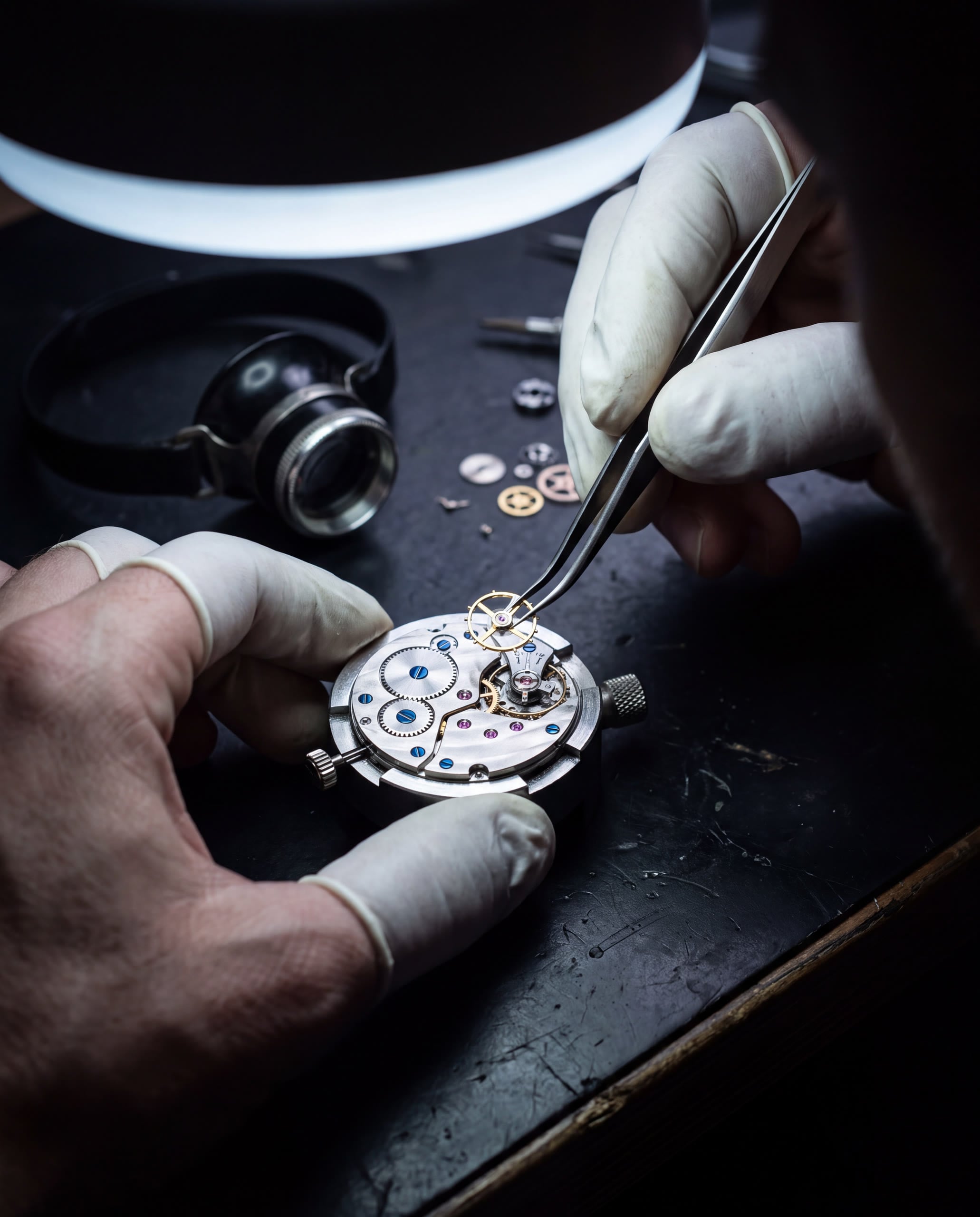
Two rooms above the Orbe.
In 1919 Lucien Sérac, son of an alpine guide, rented two rooms above the Orbe river in Le Sentier. One faced north, for even light. The other held the lathe.
His first clients were guides. A guide’s watch is not an ornament: it decides when a rope team turns back. Sérac built pocket chronometers for them, regulated in the cold and signed on the movement.
The house has moved twice since. Every bench still faces north.
- Founded
- 1919
- Founder
- Lucien Sérac
- Address
- Route de l’Orbe 19
- First work
- Alpine pocket chronometers
Chapter II
The valley
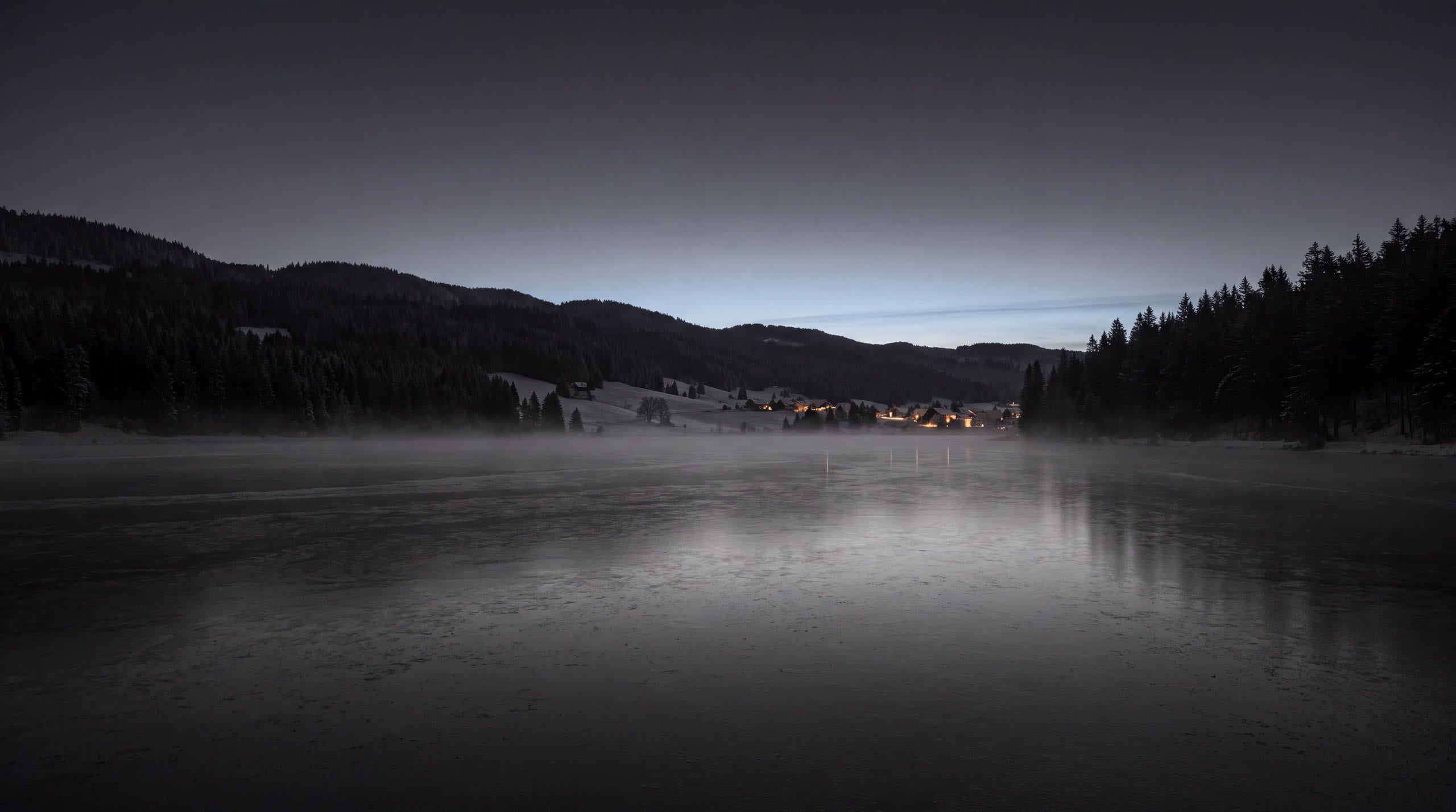
Where winters are long.
The Vallée de Joux lies at a thousand metres in the Swiss Jura, closed in by forest on both sides. Snow can stay on the valley floor from November to April.
For two centuries, farming families spent those months at benches by the window, making parts for the watchmakers of Geneva. Work that needs patience settled in a place that enforces it.
Nothing here moves quickly in winter. That is the point.
- Altitude of the Lac de Joux
- 1,004m
- Of snow, November to April
- 5months
- A common January night on the valley floor
- −20°C
Chapter III
The Traverse
Copenhagen → Anchorage → Tokyo · 1957
Two times, read at one glance.
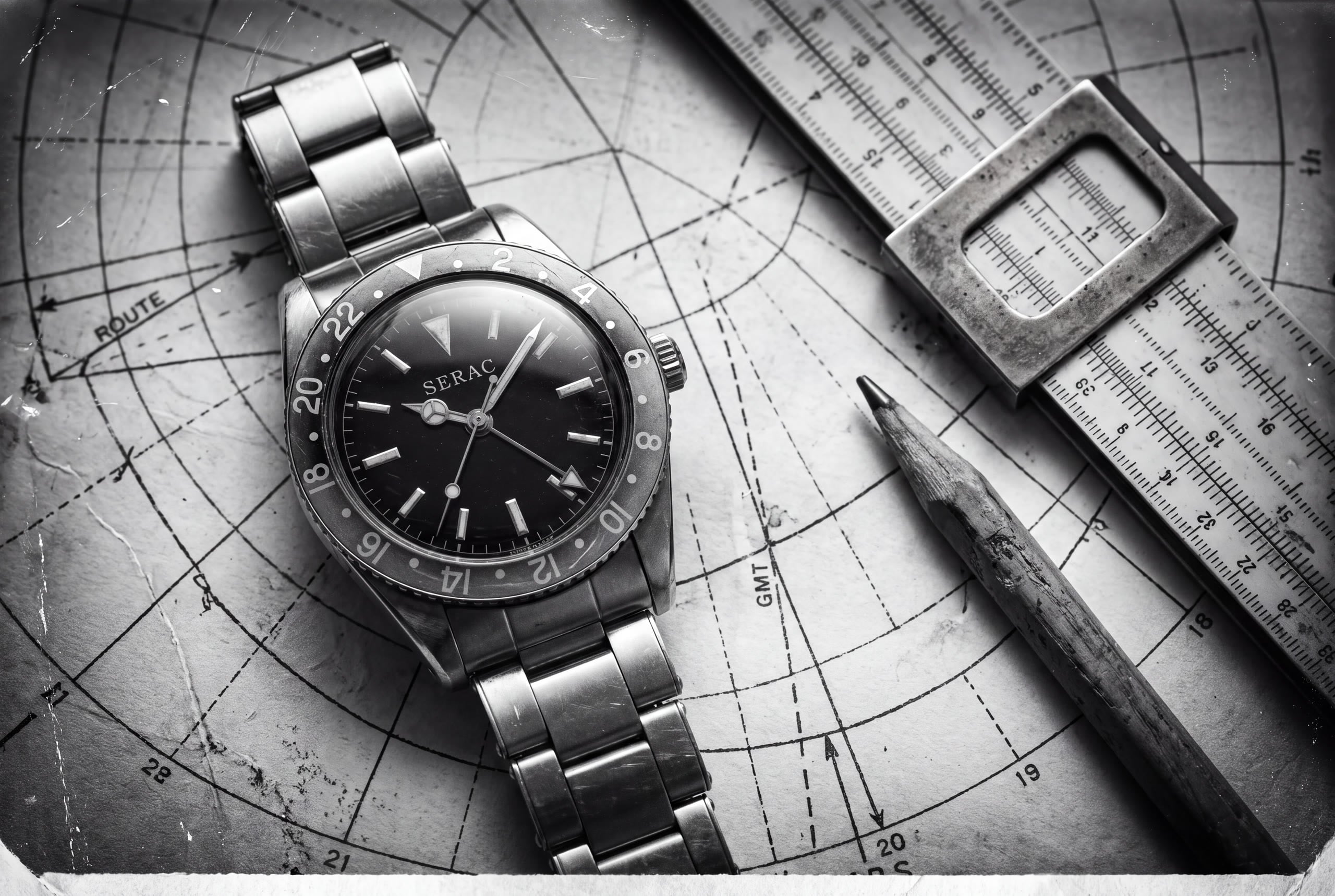
In 1957 airlines began flying from Europe to Asia over the North Pole. Near the pole every meridian meets, and a crew can cross a dozen time zones in one afternoon.
The navigators asked Le Sentier for one thing: home time they could read without arithmetic. The workshop answered with a fourth hand that turns once a day, and a bezel split in two.
The first series went to the crews flying the new route. Sixty-nine years later, the split is the same.
Reading the bezel.
Scroll to turn the hand, or set it yourself
- 01NightThe upper half of the bezel, 18 to 6. On the watch it is glacier blue.
- 02DayThe lower half, 6 to 18. On the watch it is ember red.
- 03HomeThe GMT hand turns once in 24 hours and points to home time on that scale.
- 04ElsewhereThe hour hand jumps in one-hour steps to local time. The GMT hand does not move.
- 05A third zone48 clicks, one per half hour. Turn the bezel and read a third time against the GMT hand.
Night · 18 → 6
Upper half
Day · 6 → 18
Lower half
Night at home
Chapter IV
Six dates
Six dates, one valley.
A house is measured by what it refused as much as by what it made. From the first bench to the latest calibre: 107 years.
01 — Le SentierYear one
Two rooms above the Orbe.
Lucien Sérac, son of an alpine guide, opens a workshop on the Route de l’Orbe. He builds pocket chronometers for the guides his father climbed with.
1 bench · 1 lathe · north light
02 — Jungfraujoch+15 years
Altitude.
The first SERAC wristwatch. Before it is sold, it spends a winter at 3,800 m on the Jungfraujoch, where oil thickens and steel contracts.
Tested at 3,800 m
03 — Polar routes+23 years
Traverse.
A dual-time instrument for navigators on the new flights over the pole. A 24-hour bezel splits day, in ember red, from night, in glacier blue.
24-hour bezel · 2 time zones
04 — Le Sentier+22 years
Eleven.
Quartz arrives and the valley empties. SERAC refuses it. The house shrinks to eleven watchmakers and keeps every mechanical calibre in production.
11 watchmakers · 0 quartz
05 — Le Sentier+32 years
One roof.
Cases, dials and movements are made in the same building for the first time. SERAC becomes a full manufacture.
Cases · dials · movements
06 — Le Sentier+15 years
Traverse GMT.
The 1957 instrument, rebuilt around calibre SR-24: an independent local hour hand, a 24-hour hand for home and a 72-hour reserve.
SR-24 · 4 Hz · 72 h
See the Traverse GMT, ref. TR-01
Chapter V
Three principles
What the house keeps.
Principle I01 / 03
Stillness
The calmest object in the room should be the one that keeps time.
The SR-24 beats 28,800 times an hour. None of that motion may reach the hands as error. Each movement is regulated in six positions and at three temperatures, then tested cased for fifteen days. The tolerance is −2 to +2 seconds a day.
Principle II02 / 03
Pressure
Form is what remains when everything unnecessary has been pressed out.
A 40.0 mm case, 12.1 mm thick, in one steel remelted under vacuum. One ceramic insert, split exactly in half. No crown guards. No date window. No second name on the dial. Each line has to be read in under a second, or it goes.
Principle III03 / 03
Time
We count in decades, not seasons.
The Traverse has changed four times in 69 years, each time for a reason a navigator or a watchmaker could name. Every SERAC is serviced in Le Sentier, by the bench that can still read its first service record.

Epilogue · Traverse GMT
Here. And elsewhere.
Since 1957 the Traverse has kept two times at once: the hour where you are, and the hour you left.
- Here · Your time
- —--:--
- Elsewhere · Le Sentier
- —--:--
Two zones, one dial. The red hand keeps the second.